
 LinkedIn
 ALOOSTA
 Contact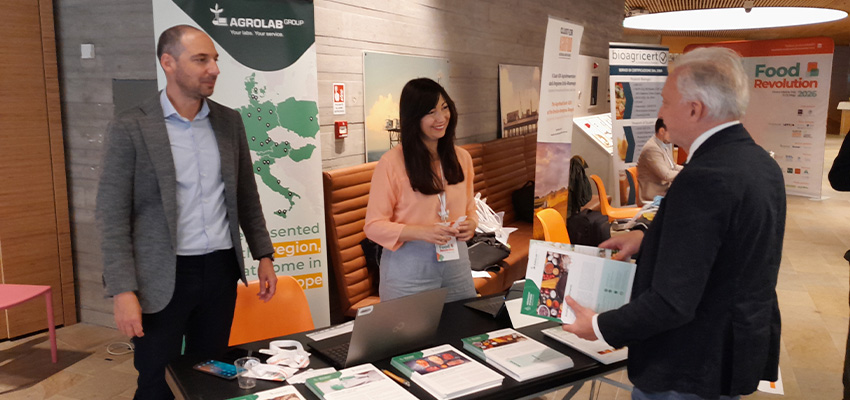
The 2nd Symposium, entitled ‘Food Revolution’, is emerging as a key interdisciplinary platform for discussions on holistic, sustainable and forward-looking food production.
By 2050, 9 billion people will need to be fed, whilst the planet faces climate change, biodiversity loss and environmental degradation. The aim of the symposium, held in Italy for the second time since 2024, was to bring together science, technology and business.
Was it successful?
As far as scientific, interdisciplinary exchange is concerned, the answer is a resounding ‘yes!’ Renowned scientists presented their work and discussed their findings with the specialist audience. The organiser, Maurizio Paleologo (Affidia), and his team provided the perfect setting for this from 11–13 May 2026 at the modern M9 museum complex in Mestre, near Venice. AGROLAB Alimentalia was involved as a sponsor of the event for the first time and presented its comprehensive range of analytical services covering the entire food production value chain – from field to plate. Unfortunately, the “food industry” was not as strongly represented as we would have expected given the high-calibre programme of talks. This may have been due to the fact that numerous trade fairs and conferences take place in parallel in May, or perhaps because the depth and urgency of the topic have not yet been recognised by some market players. However, Food Revolution III has already been announced for next year, and efforts are being made in its preparation to involve not only innovative start-ups but also established international food manufacturers.
On the first day, the focus was on sustainable agriculture, regenerative systems for adapting to global warming, and resource conservation. An important aspect of this was also the protection of agricultural soils. AGROLAB was a pioneer, having established GPS-controlled sampling methods as early as 40 years ago. Based on precise soil analyses, the company was able to offer fertiliser planning tailored to the specific crop. This ensures that crops are supplied with precisely the elements required for healthy growth. This saves costs for the farmer, reduces the burden on soil and groundwater, and promotes soil vitality. Comparable models based on digital data analysis are now also available for the intelligent use of plant protection products. Based on field-specific weather forecasts and precise monitoring of vegetation stages, infection risks – for example, for fungal diseases – can be predicted with a high degree of certainty. This helps farmers determine the right time to apply plant protection products and reduce the quantities used. One such model, for example, was developed and successfully implemented for viticulture by the German start-up ‘VineForecast’.
Naturally, the topic of targeted plant breeding using new genetic techniques was also discussed. The presentations highlighted the advantages of NGTs, whilst potential risks – for example, regarding biodiversity – and consumer information were only touched upon briefly during the breaks. (See also the article on the Non-GMO Summit.)
The second day focused on sustainable livestock farming and so-called carbon farming, which aims to reduce CO₂ emissions and sequester excess CO₂ in agricultural soils. Resource-efficient packaging technologies were also discussed. Fermentation is a millennia-old method for refining and preserving food. It is currently experiencing a renaissance in the form of innovative precision fermentation processes. These are expected to realise their great potential for the gentle production of high-quality raw materials and alternative proteins.
The third day was dedicated to ‘our’ topic! What consequences might the previously discussed proposals for sustainable, future-proof and climate-friendly agriculture have in terms of the quality of raw materials and food? Are there new risks to consider? And how can analytical methods help to identify and minimise these? In the context of alternative protein sources, for example, the question of allergenicity arises. Climate-related changes in agricultural practice may harbour previously neglected contamination risks. For instance, mycotoxins not previously detected in routine analytical testing are now emerging, for which no limit values yet exist. New plant-based foods may also contain natural toxins previously unknown in our part of the world. Even the recycling of food and packaging – which is desirable in itself – can lead to new problems that require scientific examination. It has long been known that micro- and nanoplastics, printing ink residues and environmental chemicals such as PFAS, etc., are increasingly entering the food chain.
YOUR PLUS: Our experts actively participate in relevant symposia and specialist events such as the “FOOD REVOLUTION”. In this way, we continuously expand our knowledge lead, foster professional exchange with colleagues, identify new analytical challenges at an early stage and establish new methods in a targeted manner.
Author: Dr Frank Mörsberger, AGROLAB GROUP


 Contact
 Career